Learn Python.
One step at a time.
Start with your first program. Build your confidence with explanations, worked examples and practice you can check as you go.
Any age. Any country.
At school or learning on your own.
Sign in with Google or Microsoft. No payment. You don’t need to belong to a school.
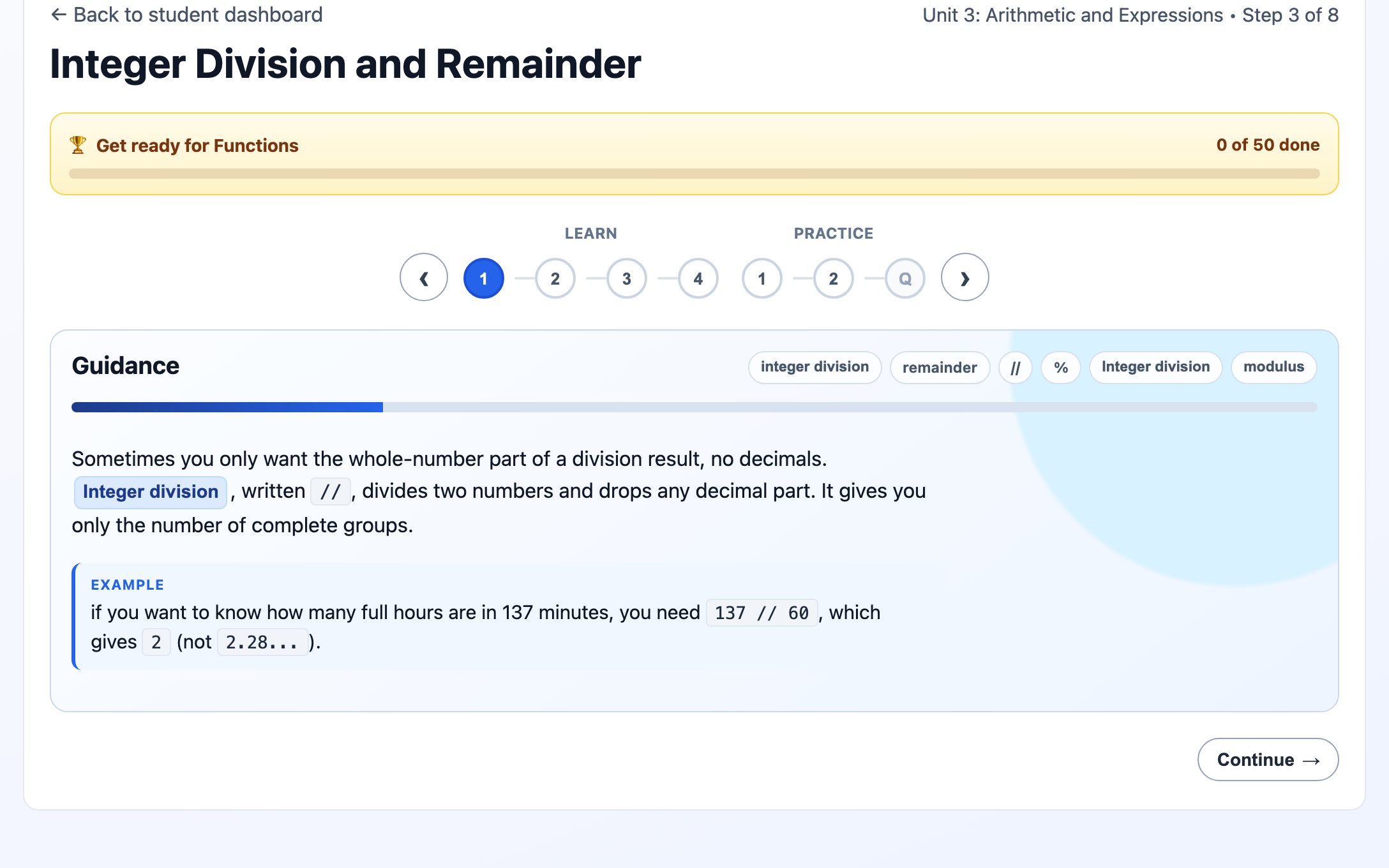 Open full-size screenshot ↗
15 unitsavailable now
Around 400 activitiesto work through
Entirely freeat your own pace
From first output
to working with files.
Start with the basics, then build towards larger programs. Open a stage to see the units inside.
Start the free course →15 units available now. Planned additions are listed separately.
01Start with the basicsOutput, input, calculations, decisions and text.+
- 01
Output & Variables
Display text and numbers, store values and use them in your programs.
- 02
Input & Casting
Ask for input and convert text to numbers when you need to calculate.
- 03
Arithmetic and Expressions
Work with calculations and understand the order Python evaluates them.
- 04
Selection and Comparisons
Use comparisons and if, elif and else to make decisions.
- 05
String Manipulation
Join, extract and format text.
02Build programs in stepsLoops, functions, breaking down problems and lists.+
- 06
Iteration with while
Repeat instructions while a condition is true, and decide when to stop.
- 07
Iteration with for
Use for loops to repeat tasks and work through sequences.
- 08
Functions (Subroutines)
Write reusable functions that take inputs and return results.
- 09
Decomposition and Abstraction
Break a larger problem into smaller steps you can solve.
- 10
Lists
Store several values in a list, then access, change and loop through them.
03Work with dataList algorithms, searching, sorting, libraries and files.+
- 11
List Algorithms
Process lists to find totals, counts, smallest and largest values.
- 12
Searching and Sorting
Learn how programs find values and put them in order.
- 13
2D Lists
Organise and access data in rows and columns.
- 14
Built-in Functions and Common Libraries
Use Python’s built-in tools and libraries such as random.
- 15
File Handling
Read data from files, write new files and add to existing ones.
What’s in development?
Further units are being developed. These are not included in the available course above.
- Validation and Edge Case Handling
- Dictionaries
- GCSE Algorithmic Project Unit
- Algorithm Analysis and Trace Tables
- OOP Foundations
- A-Level Readiness
Before you start.
Is the course really free?
Yes. The step-by-step Python course is entirely free, whether you study on your own or through school. You do not need a paid school plan to use it.
Do I need to know any Python?
No. The course begins with output and variables, then builds towards more involved programming tasks.
Do I need to install anything?
The course runs in your browser, including the code you write for its activities.
What if my school uses Coding Pathway?
Use the account and class join link your teacher gives you. The course remains free. Your school may also use Coding Pathway for lessons, homework and feedback.
Can I use it to practise for GCSE?
The course includes programming topics used at GCSE, from selection and loops to searching, sorting and file handling. Use the outline above alongside your course specification.
Write your first Python program.
Open the course, sign in and start learning Python.
Start the free courseEntirely free. No school subscription needed.